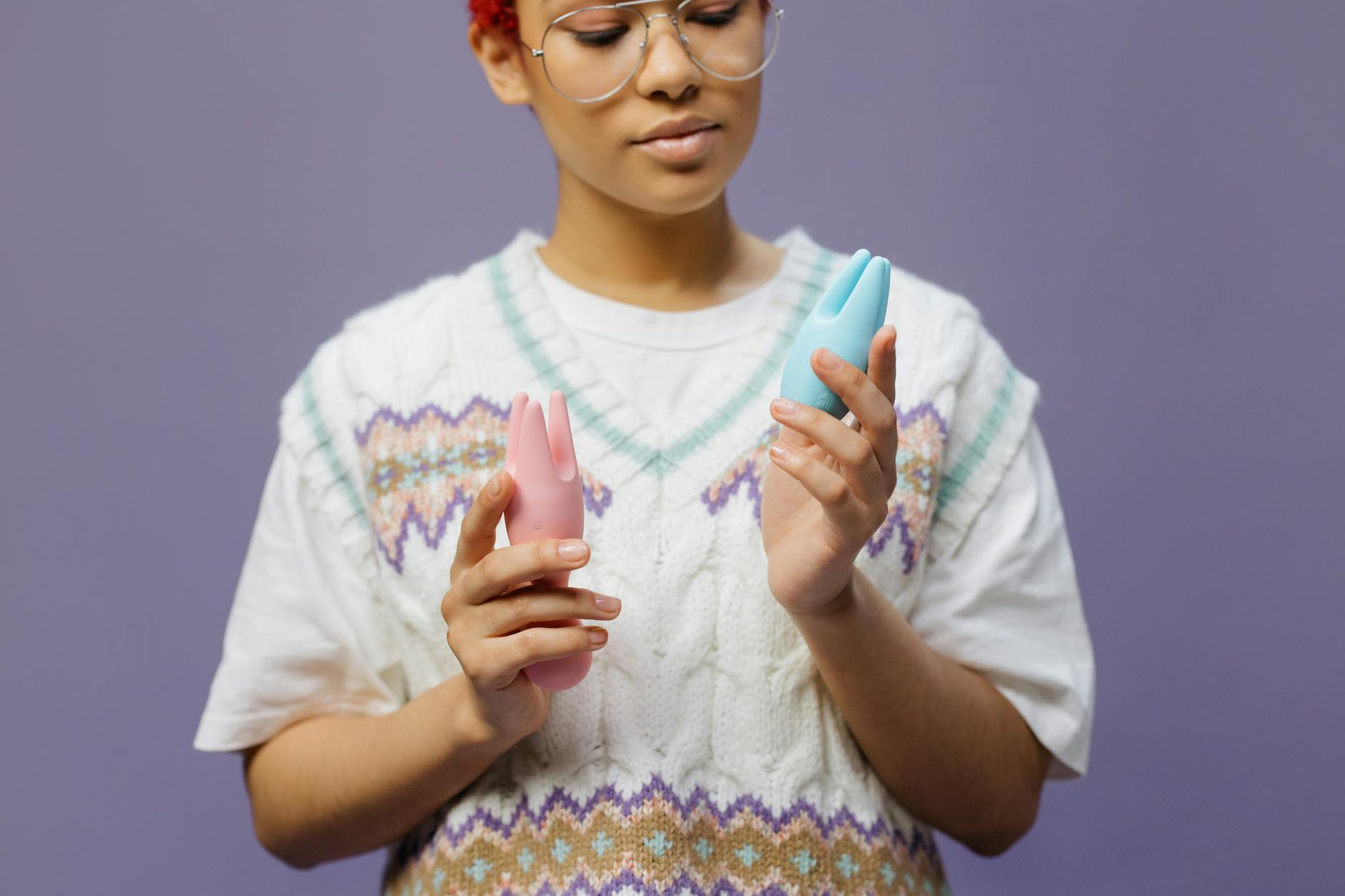
The resistance you're feeling is real. So is the solution.
Your partner winces when toys come up. Maybe they've said things like, "Aren't I enough?" or "That feels weird." Maybe silence is their response, which somehow feels worse. The impulse to back off is strong. But backing off isn't the same as resolving it, and resentment builds in that gap.
Here's what I know from decades of couples work: resistance to lemon vibrators almost never comes from the toy. It comes from fear. Fear of inadequacy, fear of change, fear of what pleasure outside the relationship might mean. Once you name the actual fear, the toy becomes negotiable again.
Why your partner might be pushing back
Three core fears show up repeatedly in my practice:
"I'm not enough." Your partner has internalized the belief that your pleasure should come entirely from them. A vibrator feels like proof they've failed. This fear is often tangled up with their own sexual insecurity or stuff from their past. It's not rational, but it's real.
"This changes what we are." Some partners worry that introducing toys means the relationship is moving toward something kinky or non-monogamous, or that you're slowly becoming less interested in them. The toy becomes a symbol of departure rather than a tool for connection.
"I don't know how to be with this." Your partner might simply feel lost. They grew up without sexual education, or their past relationships didn't involve toys, and now they're supposed to suddenly be cool with something unfamiliar. The discomfort is real even if the fear isn't fully conscious.
Naming the actual fear matters because you can't solve a fear by arguing with a toy.
Start with the conversation, not the product
The worst time to introduce a lemon vibrator is during sex or when someone's already vulnerable. The second worst is a surprise on the nightstand. The right time is when you're both calm, clothed, and have thirty minutes to actually talk.
Bring it up outside the bedroom: "I want to talk about something that's been on my mind. I know toys have come up and it's felt tense. Can we dig into what that's about for you?" This frames it as curiosity about your partner's inner world, not as pressure to perform.
Listen without defending. Your partner says, "I feel like a vibrator means I'm not satisfying you." Don't immediately counter with, "That's not true." Instead, say: "It sounds like you're worried I'm not happy with us. Help me understand where that comes from." You're investigating, not debating.
Then, tell your truth: "For me, pleasure isn't zero-sum. A lemon clitoral vibrator doesn't replace what we do together. It's actually something I'd like to explore with you, or at least not feel ashamed about. And I need you to be honest about what would help you feel okay with it."
The reframe that actually works
Stop talking about what the toy does for you. Start talking about what it does for your sex life together.
Instead of: "I want to use a vibrator because I come more easily that way." Try: "Using a lemon vibrator with you present might help me relax into pleasure more fully, which means we both get more time together in that space. That feels like something we're building, not something I'm doing alone."
Instead of: "You never touch me the right way." Try: "I sometimes get in my head about whether I'm taking too long. A vibrator takes that performance pressure off, which honestly helps me be more present with you."
The difference is subtle but critical. One positions the toy against your partner. The other positions it alongside them.
Three practical steps to move forward
Step one: Invite participation in the choice. Don't bring home a lemon vibrator and expect them to be thrilled. Instead, invite them into the selection. "I want to pick something together. Would you be open to looking at a few options with me?" Involvement breeds familiarity, which breeds comfort. They're no longer a bystander to your secret. They're a co-explorer.
Step two: Start slow and separate. Your partner might not be ready to be in the room while you use a toy yet. That's okay. Using one alone first lets you get comfortable with it, and lets them sit with the reality of it without performing. After a few solo uses, you can say, "I've been using this and I feel more relaxed in my body. Would you ever be curious to see how it feels?" No pressure attached.
Step three: Keep pleasure collaborative. When your partner is ready, the goal isn't to prove the toy is better. It's to show them it's a tool you can use together. Maybe they hold the lemon clitoral vibrator while you guide the pressure. Maybe they control the pattern while you focus on sensation. Maybe you use it on your own while they watch and touch you elsewhere. The toy becomes something you're doing together, not something you're doing to prove a point.
What resistance might sound like, and how to respond
"It's unnatural." Response: "So is antibiotics, and we use those. Technology changes how we relate to our bodies. That's not bad, it's just different."
"It means you don't need me." Response: "Need and want are different. I want to explore what feels good with you. That's connection, not replacement."
"I'm uncomfortable and I don't know why." Response: "That's honest, and I appreciate it. We don't have to rush. But I'd like us to figure it out together rather than avoiding it."
"Fine, whatever. Just don't expect me to participate." Response: "I hear you. You don't have to participate. But I also need you to be okay with me using one. Can we talk about what that boundary looks like?"
Notice what all these responses have in common: they don't give up the truth to make your partner comfortable. You're holding the boundary while inviting them to move through the discomfort.
When your partner comes around (they often do)
Many partners who start resistant become genuinely curious once the pressure lifts. Why? Because resistance often has more to do with defensiveness than actual discomfort. Once they realize you're not trying to prove anything or abandon them, the toy becomes just a tool.
This is where patience pays off. When your partner finally says, "Okay, I want to try this," don't rush into intensity. Start with them watching you. Then move to them holding the lemon vibrator. Then to them using it on you. Each step is a small act of trust and vulnerability from both sides.
How to Introduce Lemon Vibrators to a Partner Who Has Never Used Toys goes deeper into the mechanics once you've cleared the emotional hurdle.
The harder truth
Sometimes, after the conversation and patience and good-faith effort, a partner still refuses. They won't engage, won't listen, won't budge. That's information too. It tells you whether your partner can actually meet you in your sexual autonomy, which is a real compatibility question.
You get to want pleasure. You get to explore what that means. How to Use a Lemon Vibrator When You're Nervous About Pleasure talks about reclaiming that right when outside judgment (including from partners) makes you doubt it.
Your sexual life is not a referendum on your relationship's value. A lemon clitoral vibrator doesn't threaten a solid partnership. But a partnership where you have to shrink your pleasure to keep someone comfortable? That threatens you.
When to bring in professional support
If you've had multiple conversations and nothing shifts, couples therapy might be the right move. A therapist can help your partner understand their fear without you being the bad guy. They can also help you both figure out whether this is a dealbreaker for you, or whether there's a compromise that lets you both feel respected.
This isn't about forcing toy use. It's about creating space for your partner to examine why toys feel so threatening, and for you to know whether your partner is capable of supporting your sexual autonomy even when it looks different from their own.
People also ask
What do I do if my partner says using a lemon vibrator is cheating?
That's a core values question disguised as a toy question. Ask: "What makes it feel like cheating to you?" Usually the answer is about intimacy, attention, or pleasure happening outside the relationship. Those are real feelings worth addressing, but they're not solved by avoiding toys. They're solved by understanding what intimacy and fidelity actually mean to both of you. Some couples define cheating as emotional connection outside the relationship. Others define it as penetrative sex. Others don't define it that way at all. You need to know what your partner actually means by the word before you can solve it.
Should I hide my lemon vibrator use if my partner doesn't approve?
Not indefinitely. Hiding teaches both of you that your pleasure is shameful, which erodes intimacy over time. It also builds resentment on your side and, eventually, betrayal on his side when he finds out. Short-term privacy while you're working through the conversation? Fine. Long-term secrecy? That's slow poison. Your partner might not like that you use a vibrator, but they need to be honest about that rather than forcing you underground.
What if my partner wants to throw out my toys?
That's a boundary violation. Your sexual autonomy isn't something a partner gets to overrule. If your partner is trying to control your body or your choices, that's a bigger problem than toy resistance. You might need to be very direct: "My toys stay. My body is mine. If you're uncomfortable with that, we need to talk to someone who can help us navigate it."
Can lemon vibrators actually help a resistant partner relax?
Yes, sometimes. Once the emotional work is done and a partner gets curious, actually using a lemon vibrator together can shift things. The physical sensation combined with the shared vulnerability can open doors that conversation alone couldn't. But that only works if the emotional groundwork is solid first.
How long should I wait for my partner to come around?
There's no timeline. But there's a difference between "they're processing and need time" and "they're blocking you indefinitely." A few months of real conversation and genuine curiosity from your partner is reasonable. A year of stalling or dismissal is information that they might not be capable of this shift. Only you know what you can live with.
Is it weird to use a lemon clitoral vibrator alone if my partner isn't comfortable with it yet?
Not weird at all. Using a vibrator on your own is actually a great way to get comfortable with it, to understand your body better, and to show your partner that it's not a threat to your relationship. Solo exploration often makes partners less defensive because you're not asking them to perform or participate. They can just slowly acclimate to the reality.
Your pleasure matters. Your partner's comfort matters. But your pleasure doesn't have to be sacrificed for their comfort, and their comfort doesn't have to be sacrificed forever for your exploration. The work is in finding the space where both can be true at once. That's where real partnership lives.
If this conversation feels too hard to navigate alone, contact us to talk through next steps. Sometimes a neutral conversation starter makes all the difference.